

The project “advanced QUAntum Spectroscopy for hAzaRds detection” (QUASAR) is funded by the NATO Science for Peace and Security (SPS) Programme (id G7883).
It is coordinated by ENEA (Italy) and involves Griffith University (Australia), the University of Roma Tre (Italy), and the Italian company NUCLECO S.p.A. as end-user.
Quantum technologies (QTs) offer powerful tools for a wide range of applications and can be efficiently employed in realistic scenarios, including those related to security. In this context, Quantum Sensing is emerging as one of the most mature QTs, with strong potential for translation from laboratory demonstrations under controlled conditions to real-world implementations. In this framework, the main goal of QUASAR is to develop advanced quantum sensors whose performance is enhanced through the exploitation of quantum resources.
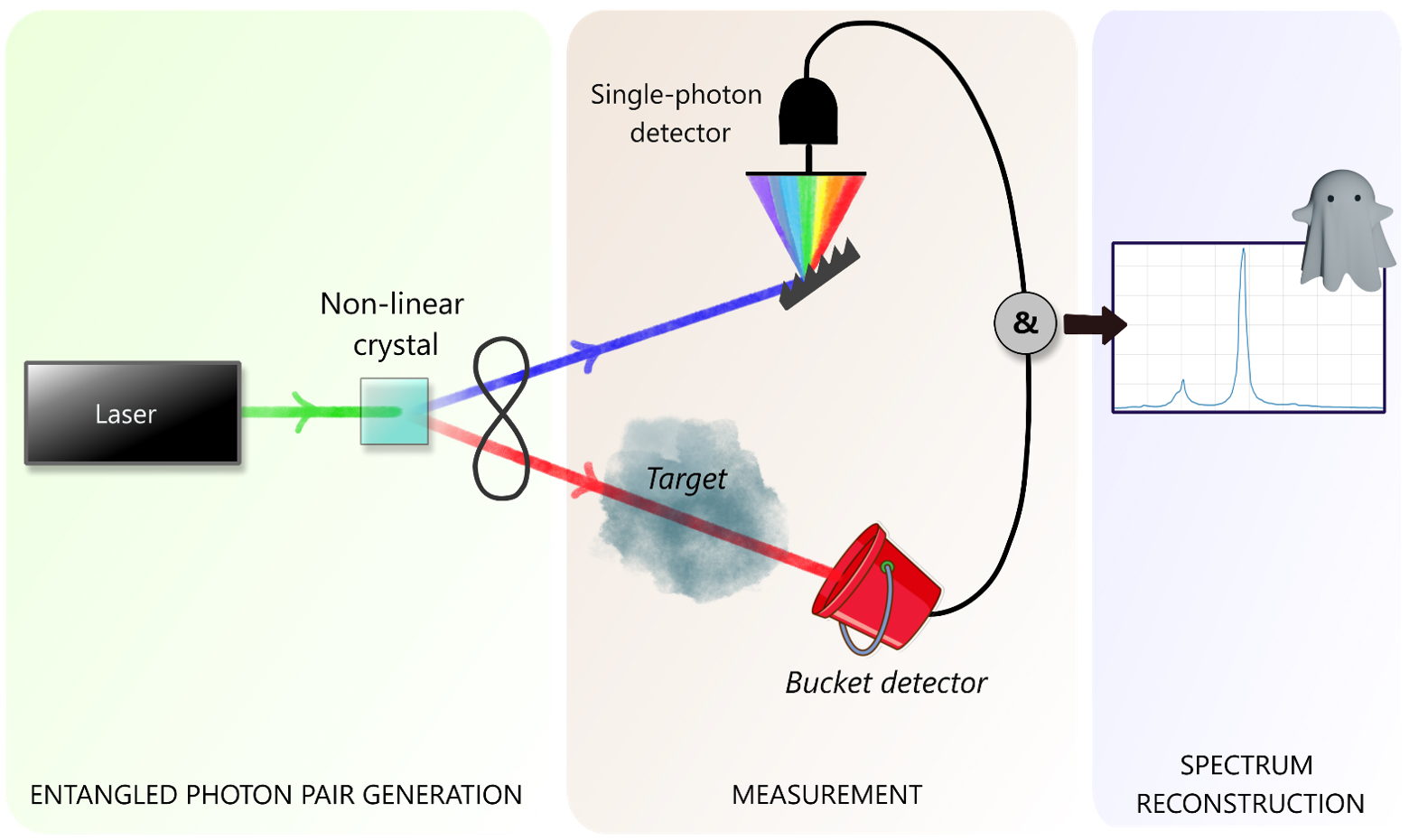
To achieve this, the project builds upon the approach of Quantum Ghost Spectroscopy (QGS), that is the counterpart in the frequency domain of Quantum Ghost Imaging (QGI). These methods allow to reconstruct the image or spectrum of an object without analysing the light directly interacting with it. The trick is to build the desired spectrum using another radiation with a different wavelength, never interacting with the object but “strongly” correlated to the radiation that traversed it. The strong correlation between two photons is called entanglement, one of the most intriguing properties of quantum mechanics: two objects are entangled if they are intrinsically linked as a unified system and the behaviour of one instantaneously influences the other, regardless of the distance between them.
SUB-PROJECT | TASKS | |||||
|---|---|---|---|---|---|---|
1. PROJECT MANAGEMENT | TASK 1.1 - Project coordination | |||||
TASK 1.2 - Data, communication, dissemination and exploitation | ||||||
TASK 1.3 - Networking and multidisciplinary community | ||||||
TASK 1.4 - Stakeholders Engagement Strategy | ||||||
2. DEVELOPMENT OF DEGENERATE AND | TASK 2.1 - Broadband non degenerate Source |
|
| |||
TASK 2.2 - Multi DOF boadband source | ||||||
TASK 2.3 - Accessing the UV regime | ||||||
3. DEVELOPMENT OF SINGLE | TASK 3.1 - VBG-based frequency resolved measurement |
|
| |||
TASK 3.2 - Frequency resolved measurement based on highly dispersive customized materials | ||||||
TASK 3.3 - SPAD Array-based frequency resolved measurement | ||||||
4. INTEGRATION AND MINIATURAZATION |
|
| TASK 4.1 - QGS Setup realization and integration |
| ||
5. OPTIMIZATION AND DATA ANANYSIS THROUGH |
|
|
| TASK 5.1 - Tunable source control | ||
|
|
| TASK 5.2 - Spectral recognition | |||
6. SYSTEM VALIDATION AND FINAL DEMO |
|
|
|
| FINAL DEMO | |
The measurement strategy proposed by QUASAR relies on quantum correlations, which offer clear advantages over classical methods, such as higher quality signals (better signal-to-noise ratio) and the possibility of performing measurements with low flux of radiation or using only minimal amounts of samples. This is particularly valuable in situations where the target is unknown (and high-power lasers cannot be used), difficult to reach, potentially hazardous, or where environmental noise affects the data, as often happens in real-world conditions. These are exactly the kinds of challenges faced when detecting and identifying CBRN threats, such as harmful gases, volatile organic compounds (VOCs), post-explosion residues, and different types of nuclear waste. All these substances pose serious risks to operators, civilians, and the environment.
Achieving the goals of QUASAR will therefore have a twofold impact: on the one hand, it will mark a significant improvement in the process of equipping the operators in hostile scenarios with innovative and better performing high-tech hardware and software; on the other, it will highlight how quantum technologies can deliver superior solutions and enhanced performance, with increasingly mature applications across the civil, military, and industrial sectors.
The NATO Science for Peace and Security (SPS) Programme is a NATO initiative that promotes practical, security-related cooperation between NATO member states and partner countries through scientific research, technological innovation, and knowledge exchange. Since its foundation in 1958, the SPS Programme has continuously evolved, with a major reorientation in 2013 that gave it a renewed focus on larger-scale strategic activities beyond purely scientific cooperation.
The NATO Science for Peace and Security (SPS) Programme (http://www.nato.int/science) is a NATO initiative that promotes practical, security-related cooperation between NATO member states and partner countries through scientific research, technological innovation, and knowledge exchange. Since its foundation in 1958, the SPS Programme has continuously evolved, with a major reorientation in 2013 that gave it a renewed focus on larger-scale strategic activities beyond purely scientific cooperation. Today the Programme aims at linking science and security, using research and technology as tools for peace, stability, and international collaboration.
The SPS Programme connects scientists, experts and officials from Allied and partner countries by funding multi-years collaborative projects, workshops, training course, and expert networks. These initiatives tackle a wide range of security challenges, including cyber defence, counter-terrorism, disaster response and resilience, protection against chemical, biological, radiological, and nuclear (CBRN) threats, as well as energy and environmental security. The Programme also fosters the development of advanced security technologies (e.g., sensors, detectors, nanotechnologies, and unmanned aerial vehicles (UAVs)) and addresses human and social aspects of security, such as the implementation of the United Nations Security Council Resolution 1325 on Women, Peace and Security (UNSCR 1325).
The SPS Programme benefits from the expertise of NATO agencies, divisions, delegations, and centres of excellence, ensuring that projects are grounded in both scientific excellence and strategic relevance. Through these efforts, the Programme not only contributes to advance science and innovation, but also provides a unique channel for non-military communication, fostering dialogue and cooperation with partner countries. It enables NATO to engage in regions where other forms of dialogue are difficult and often serves as the first concrete link between NATO and new partners, including those in Eastern Europe, the Middle East, North Africa, and Central Asia.
In summary, the SPS Programme helps address emerging security challenges and contributes to international peace and stability through scientific research and technological innovation, promoting the use of science for the benefit of security and society.